

You walk outside with your morning coffee, ready to enjoy a quiet moment on your deck. But instead of peace, you notice a wobbly railing. A cracked board catches your eye. The surface feels rough under your bare feet.
Your deck has seen better days.
Then you wonder: Do I really need to tear this whole thing down and start over? The answer might surprise you. Many homeowners assume that a damaged deck means automatic replacement, but repair is often a realistic option that saves both time and money.
When Repair Makes Sense (And When It Doesn’t)
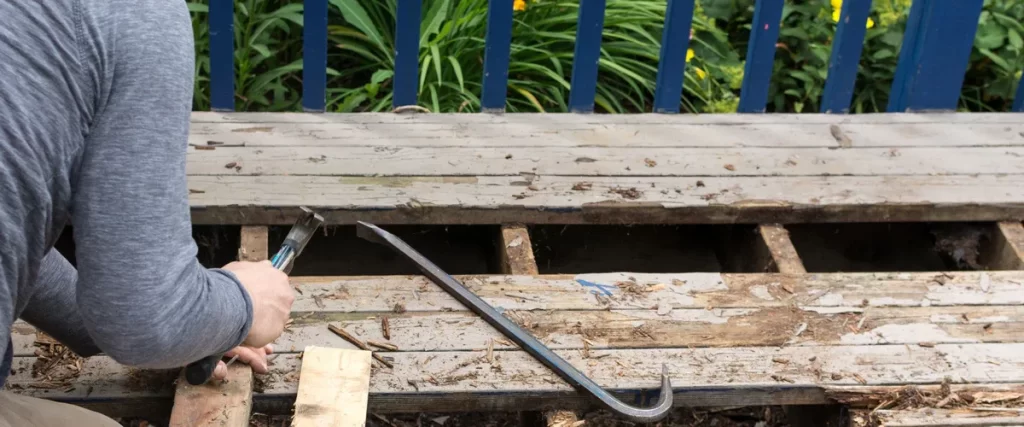
Not every deck problem requires a complete teardown. Some issues are surface-level annoyances that you can handle with targeted fixes. Others run deeper.
The trick is knowing which category your deck falls into.
Signs Your Deck Can Be Saved
Your wooden deck might just need some attention if you’re dealing with:
- Faded or peeling stain: Surface damage from sun exposure and weather doesn’t mean the wood underneath is compromised. Re-staining can bring your deck back to life.
- A few damaged boards: Isolated cracked or splintered deck boards are easy to replace without touching the rest of the structure.
- Loose screws or nails: Deck screws that have worked themselves free over time can be tightened or replaced. Simple fix, big improvement.
- Minor surface cracks: Small cracks in the deck surface can be filled and sealed before they spread.
- Mold or mildew buildup: Pressure washing with warm water usually handles this problem, especially if caught early.
Red Flags That Scream Replacement
Some problems can’t be patched over. Safety issues and structural damage fall into this category.
You’ll want to consider full deck replacement if you notice:
- Widespread rot: When multiple boards or support beams show signs of wood rot, repair costs can actually exceed replacement. At that point, you’re throwing good money after bad.
- Structural issues with the foundation: If the posts, beams, or joists are failing, your deck’s structural integrity is compromised. This isn’t something you can Band-Aid.
- Sagging or bouncing deck surface: A deck that moves under your weight has serious problems underneath. The wood fibers in the support structure may have degraded beyond repair.
- Failing connections to the house: According to the International Code Council, the ledger board connection is one of the most common failure points. If this is compromised, frequent repairs won’t cut it.
- More than 25 years of age with minimal maintenance: An old deck that hasn’t been properly cared for often has damage you can’t see until you start digging.
Common Deck Problems You Can Actually Fix
| Problem | Fix | Time Investment | Skill Level |
| Weathered, gray surface | Clean, sand, and restain | Weekend project | Beginner |
| Single cracked board | Board replacement | 2-3 hours | Beginner |
| Wobbly railings | Tighten or replace fasteners | 1-2 hours | Beginner |
| Small areas of rot | Cut out the damaged section, install new wood | 4-6 hours | Intermediate |
| Loose deck boards | Add new deck screws | 1-2 hours | Beginner |
| Surface splinters | Sand and seal | Half day | Beginner |
The Fix-It Process: What Actually Works
Let’s walk through the repair process. This is what actually gets results.
Step 1: Inspect Everything
Start at the top and work your way down. Check each deck board for damage. Test the railings by pushing on them. Get underneath if you can and look at the support structure. Poke suspicious areas with a screwdriver to check for soft spots that indicate rot.
Take notes. Take pictures. You need a clear picture of what you’re dealing with.
Step 2: Clean Before You Commit
Sometimes a deck just looks worse than it is. A pressure washer can work wonders. Use a fan tip and keep the pressure washer wand moving to avoid damage to the wood grain. Mix warm water with a deck-specific cleaner for best results.
After cleaning, let the bare wood dry completely. This usually takes 48 hours in good weather. You might be pleasantly surprised at what’s underneath years of dirt and mildew.
Step 3: Replace What’s Broken
Bad boards need to go. Period. Use a circular saw to cut out damaged sections. Match the new wood to your existing decking materials, whether that’s pressure-treated lumber, redwood, or composite decking.
Here’s where people make mistakes: they try to reuse old deck screws or use regular screws instead of exterior-grade fasteners. Don’t do that. Use corrosion-resistant deck screws rated for your specific material.
Step 4: Sand and Prep
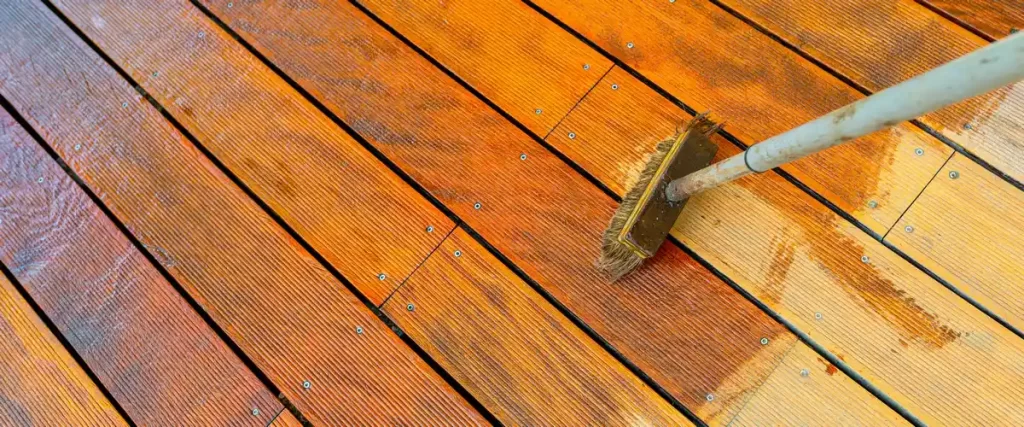
Once repairs are done, sand the entire deck surface. Start with 60-grit sandpaper for rough spots and finish with 80-grit. This opens up the wood grain and removes splinters. It’s time-consuming but necessary for a good finish.
Use an orbital sander for large areas and hand sand the railings and edges. Vacuum or sweep thoroughly when done.
Step 5: Apply New Protection
Your wood deck needs a coat of protection. You have options: stain, paint, or clear sealer. Most people go with a new stain because it penetrates the wood and highlights the natural grain.
Apply with a brush for railings and tight spots. Use a roller for large deck surfaces. Follow the wood grain. Let each coat dry completely before adding another. Two coats minimum.
When Composite Decks Need Attention
Composite decks don’t rot like wood, but they’re not maintenance-free. Scratches, stains, and fading can still happen. The good news is that repairs are usually simpler.
Most composite deck issues are cosmetic. Pressure washing removes most stains. Deep scratches might need board replacement, but the installation process is straightforward since composite materials don’t require the same prep as wood.
Curious about making the switch from wood to composite? Our team has written extensively about the pros and cons. Worth a read if you’re thinking about long-term solutions.
The Real Cost Breakdown
Money matters. Let’s be honest about what you’re looking at.
A full deck replacement typically runs between $15 to $35 per square foot for wood, and $25 to $50 for composite. For a standard 300-square-foot deck, that’s anywhere from $4,500 to $15,000.
Compare that to repair costs:
- Replacing 10-15 damaged boards: $300-$800
- Complete re-staining: $500-$1,500 (professional) or $150-$400 (DIY)
- Railing repair or replacement: $400-$1,200
- Fixing minor structural issues: $800-$2,500
The math is pretty clear. If your repair costs stay under 50% of replacement cost and the underlying structure is sound, repair makes financial sense.
What About DIY vs. Professional Help?
Some fixes you can handle yourself. Others? Not so much.
Surface work like cleaning, sanding, and staining falls squarely in DIY territory. Replacing a few deck boards is manageable if you’re comfortable with basic tools. Tightening loose screws requires nothing more than a drill.
But structural repairs need professional eyes. Anything involving load-bearing components, connections to your house, or widespread damage should get expert attention. One mistake with the foundation or support beams creates safety issues that put your family at risk.
If you’re noticing sagging, bouncing, or any sign that the deck’s structural integrity is questionable, call someone who knows what they’re doing. This isn’t the place to learn on the job.
Want to understand more about what keeps your deck safe? Check out how weather protection plays into long-term maintenance. Prevention beats repair every time.
How Long Will Repairs Actually Last?
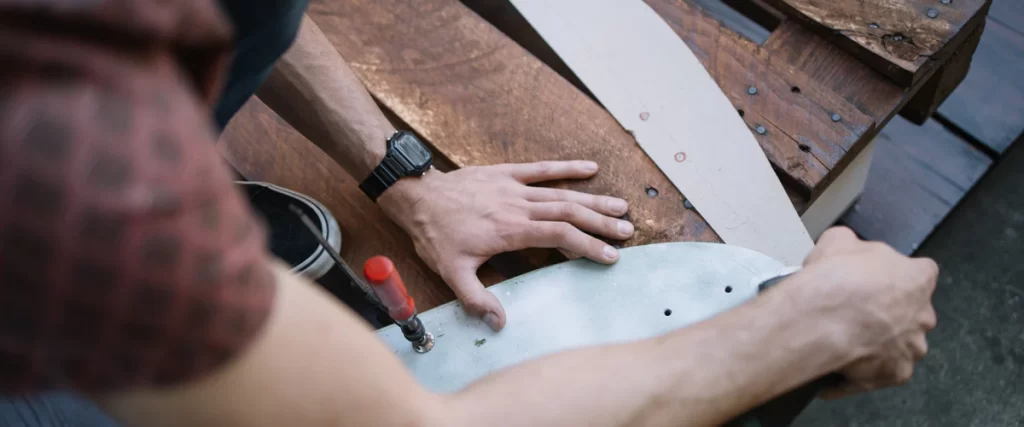
Here’s what nobody tells you upfront: repairs are a stopgap, not a permanent solution.
A properly repaired wood deck can give you another 5-10 years, sometimes more if you stay on top of maintenance. That means regular cleaning, annual inspections, and re-staining every 2-3 years. Miss these steps, and you’re back to square one faster than you’d think.
The long run matters. If your deck is already 20+ years old and you’re doing frequent repairs, you might be in that zone where replacement becomes the smarter financial move. Think about it like an old car. At some point, the repair bills exceed the value of just getting a new one.
Maintenance That Actually Prevents Future Damage
Prevention sounds boring until you’re staring at a $10,000 replacement bill.
Here’s what works:
- Clean your deck twice a year with a pressure washer or deck cleaner
- Verify all fasteners are tight and replace any missing deck screws
- Inspect for early signs of rot or damage, especially after harsh weather
- Keep furniture and planters on protective pads to prevent moisture trapping
- Trim back vegetation that touches the deck and holds moisture against the wood
- Seal or stain on a regular schedule, not just when it looks bad
Do these things, and you’ll catch problems when they’re small and cheap to fix.
If you’ve got questions about local building codes that might affect your repairs, that’s another area where a little homework goes a long way. Some repairs require permits, especially if they involve structural changes.
Frequently Asked Questions
How do I know if my deck rot is too extensive to repair?
Poke the wood with a screwdriver. If it sinks in easily or the wood feels spongy in multiple locations, especially in support beams or joists, you’re looking at replacement territory. Surface rot on a few deck boards is repairable. Widespread rot through the structure is not.
Can I just paint over a weathered deck instead of sanding and staining?
You can, but you shouldn’t. Paint sits on top of the wood and will peel off if applied over weathered, unsanded surfaces. Stain penetrates the wood and lasts longer. If you want paint, you still need to sand and prime first.
Is pressure washing safe for all deck types?
Generally, yes, but technique matters. Keep the pressure washer nozzle at least 12 inches from the surface and use a fan tip. Too much pressure or a concentrated stream can damage wood fibers and create furring. Composite decks can handle slightly more pressure than wood.
How often should I stain my wood deck?
Every 2-3 years for decks in full sun or harsh weather. Shaded decks in mild climates might stretch to 4 years. If water stops beading on the surface and soaks in instead, it’s time to restain.
What’s the difference between deck repair and deck restoration?
Repair targets specific problems like broken boards or loose railings. Restoration is a complete overhaul of the deck surface: deep cleaning, sanding, fixing all minor issues, and applying new finish to the entire deck. Restoration costs more but gives you a like-new result without rebuilding.
Do composite decks ever need repairs?
Less often than wood, but yes. Composite boards can crack, stain, or fade. Individual boards can be replaced. Scratches can sometimes be buffed out or filled. Fasteners can still loosen over time and need attention.
Can I mix new pressure-treated wood with old on my deck?
Yes, but expect color differences. New pressure-treated lumber has a greenish tint that will eventually fade to gray. Old boards are already gray. The colors will blend over time, or you can stain everything to match immediately.
Maybe You’d Rather Just Call Someone
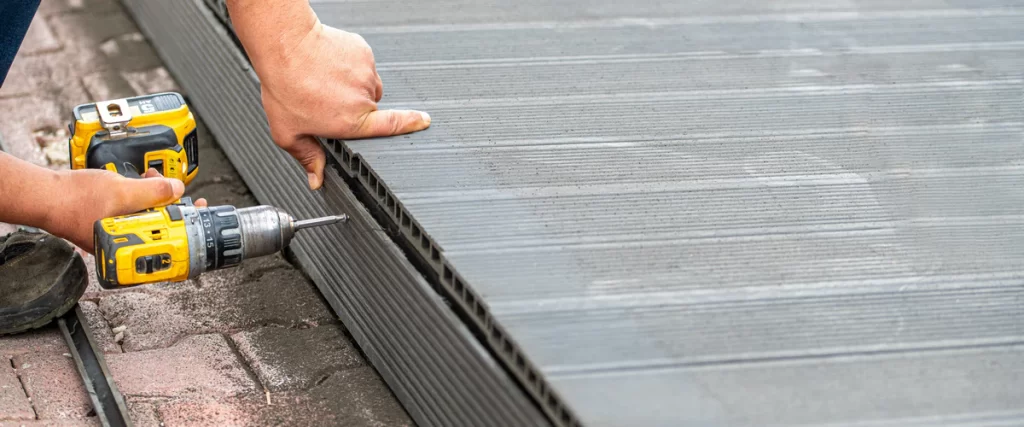
Look, we’ve just walked through everything you need to know about fixing a deck without rebuilding. The cleaning, the sanding, the board replacement, the staining. It’s doable. It’s also a decent amount of work.
Maybe you read all this and thought, “Yeah, that’s exactly what I want to spend my weekend doing.” Great. You’ve got a roadmap.
Or maybe you got to the part about crawling under the deck to check for rot and thought, “Absolutely not.”
That’s fair too.
Sometimes the smartest move is admitting that your time is worth more than the money you’d save doing it yourself. Plus, there’s something to be said for having someone who’s done this a hundred times take a look at your deck and tell you exactly what needs fixing and what doesn’t.
If that sounds better than spending your Saturday with a sander and a can of stain, we’re here.
For professional deck repair services, reach out at (865) 801-4545 or our contact page, and let’s talk about what your deck actually needs.